Mastering New Year Elements: A Practical Guide to Quality, Scalability, and Smart Usage
The transition into a new year brings a surge of creative demand. Whether you are a small business owner updating your social media presence, a marketer designing campaign assets, or a hobbyist creating personalized greeting cards, the visual language of the season is essential. New Year Elements serve as the foundational building blocks for these projects, offering everything from festive typography to intricate decorative motifs. However, not all digital assets are created equal. Many creators rush into downloading free or low-cost packs without evaluating their technical specifications, leading to frustrating workflow bottlenecks and subpar final products.
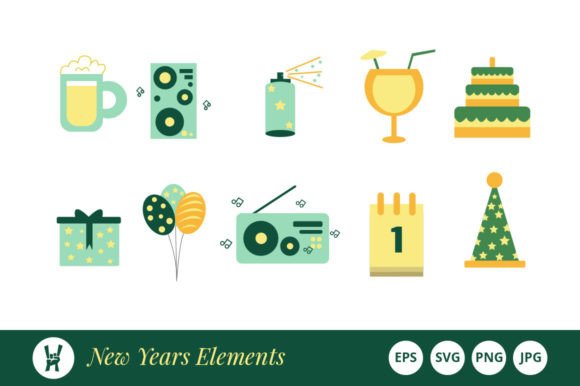
Understanding what constitutes a high-quality asset pack is crucial for maintaining professional standards and efficiency. A premium collection should not just look good in a preview image; it must perform reliably across various mediums. This is why comprehensive packages often include multiple file formats, such as 10 EPS Vector files, 10 SVG Vector files, 10 PNG files with transparent background, and 10 JPG files. These formats ensure that whether you are printing a large-format banner or designing a quick Instagram story, you have the right tool for the job. Yet, even with the right files, common mistakes in selection and application can undermine your creative efforts.
The Trap of Ignoring File Formats and Scalability
One of the most frequent errors beginners make is overlooking the importance of vector versus raster graphics. You might find a beautiful snowflake or champagne glass illustration, but if it is only available as a low-resolution JPG, you are immediately limited. When you attempt to scale this image for a large print banner or a high-definition web header, it becomes pixelated and blurry. This lack of clarity reflects poorly on your brand or personal project, signaling amateurism rather than celebration.
To avoid this, always prioritize assets that offer EPS and SVG options. These vector formats are mathematically defined, meaning they are easy edit and scalable to any size without losing quality. For instance, if you are designing a logo for a New Year’s event, an SVG allows you to resize the graphic for a business card or a billboard with identical sharpness. Relying solely on JPGs restricts you to specific dimensions and makes editing colors or shapes nearly impossible without advanced software skills. By choosing a pack that includes both vector and raster options, you future-proof your designs and ensure versatility across different platforms.
Overlooking Transparency in Layered Designs
Another critical aspect often ignored is the background transparency of raster images. Many creators download PNGs that appear to have clear backgrounds but actually contain white or colored boxes around the elements. When you place these onto a colored web background or a textured scrapbook page, the unwanted box disrupts the composition. This issue is particularly prevalent in hurriedly assembled freebie packs.
A professional-grade set of New Year Elements will provide PNG files with transparent background that are meticulously cut out. This allows for seamless integration into complex layouts. For example, if you are creating a social media banner with a gradient background, transparent PNGs ensure that your festive icons blend naturally rather than sitting awkwardly on top. Always test your PNGs by placing them over a dark and a light background before committing to a large project. If the edges look jagged or carry a halo effect, the asset is not suitable for professional use.
Misjudging Editability and Customization Needs
Many users assume that "vector" automatically means "easy to edit." While vectors are editable, the complexity of the file matters. Some EPS files contain thousands of unnecessary anchor points or grouped layers that are difficult to separate. This can make simple tasks, like changing the color of a ribbon or adjusting the thickness of a line, unnecessarily time-consuming. For professionals working under tight deadlines, this inefficiency can be costly.
Before purchasing or downloading, check if the vectors are well-organized. Can you easily ungroup elements? Are the layers named logically? High-quality packs are designed with the user in mind, ensuring that each element is distinct and manageable. If you are using software like Adobe Illustrator or CorelDRAW, having clean paths allows for quick customization. For those using simpler tools, SVGs are often more compatible and easier to manipulate directly in web design platforms or basic graphic editors. Understanding your own software capabilities and matching them with the right file type is key to a smooth workflow.
Contextual Mismatch and Overuse
Beyond technical specifications, a common aesthetic mistake is the overuse or misapplication of elements. Just because a pack contains ten different designs does not mean you should use all of them in one project. Cluttered designs dilute the message and overwhelm the viewer. Whether you are working on scrapbooking, banners, web backgrounds, or craft projects, restraint is often more impactful than abundance.
Consider the context of your audience. A corporate New Year’s email newsletter requires a different tone than a children’s party invitation. Using overly whimsical or chaotic elements in a professional setting can undermine credibility. Conversely, sterile, minimalistic designs might feel cold for a family-oriented holiday card. Evaluate the style of the New Year Elements against your brand voice or personal intent. Look for cohesion in color palettes and line weights. A well-curated pack will offer variety while maintaining a consistent artistic direction, allowing you to mix and match without creating visual discord.
Verifying Licensing and Usage Rights
Finally, many creators overlook the legal aspects of using digital assets. Using an element for a graphic design client project versus a personal scrapbooking hobby may have different licensing requirements. Some free resources prohibit commercial use, while others require attribution. Ignoring these terms can lead to copyright strikes or legal issues, especially for entrepreneurs and freelancers who monetize their content.
Always read the license agreement included with your download. Ensure that the pack allows for the intended use, whether it is for social media banners, printed cards, or commercial products. Reputable providers clearly state these terms. Investing in a properly licensed pack not only protects you legally but also supports the artists who create these resources, fostering a healthier creative ecosystem.
In conclusion, selecting and using New Year Elements effectively requires more than just an eye for beauty. It demands a practical understanding of file formats, scalability, transparency, editability, and licensing. By avoiding common pitfalls such as relying on low-resolution JPGs, ignoring transparency issues, and overcomplicating designs, you can elevate the quality of your work. Whether you are a beginner exploring craft projects or a professional managing large-scale marketing campaigns, taking the time to evaluate your assets ensures that your final output is polished, professional, and perfectly suited for the celebratory spirit of the season.