Visualizing Complexity: How the Data Structure Icon Set Elevates Modern Digital Communication
In an era where digital literacy is no longer a niche skill but a fundamental requirement, the ability to communicate complex technical concepts visually has become paramount. For professionals, creators, entrepreneurs, and marketers, the challenge often lies not in understanding data structures, but in explaining them to stakeholders, clients, or users who may lack a technical background. This is where the Data Structure Icon Set emerges as a critical asset. It is more than a collection of graphics; it is a bridge between abstract logic and tangible understanding, transforming dense algorithmic concepts into accessible visual language.
The demand for high-quality, versatile vector graphics has surged alongside the growth of software documentation, educational platforms, and tech-focused marketing. As businesses strive to make their products appear more intuitive and user-friendly, the visual representation of backend processes becomes a key differentiator. The Data Structure Icon Set addresses this need by providing a comprehensive library of symbols that represent arrays, linked lists, trees, graphs, and hash maps with clarity and aesthetic precision.
The Strategic Value of Visual Abstraction in Tech
Why are professionals paying attention to specialized icon sets like this? The answer lies in the changing expectations of modern consumers and the evolving workflows of creative teams. In the past, technical documentation was often text-heavy, relying on jargon that created barriers to entry. Today, the trend is toward visual storytelling. Whether you are a freelancer designing a landing page for a SaaS product or an entrepreneur pitching a new database solution to investors, the ability to simplify complexity is a competitive advantage.
The Data Structure Icon Set fits into broader industry trends by aligning with the movement toward developer experience (DX) and user experience (UX) convergence. Companies are realizing that if developers find a tool easy to understand visually, they are more likely to adopt it. Similarly, end-users are more trusting of applications that appear transparent and organized. By utilizing standardized, professional icons, creators can signal competence and clarity, reducing cognitive load for their audience.
Diverse Styles for Multifaceted Needs
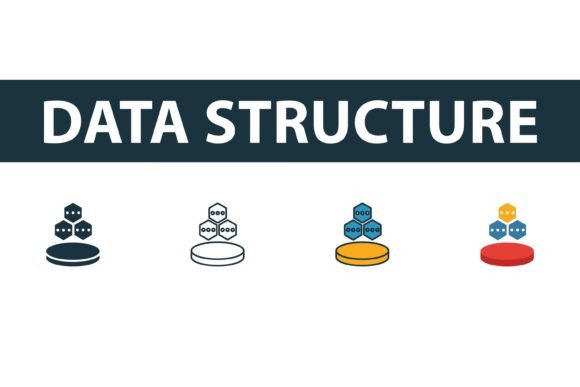
One of the standout features of this collection is its versatility. A single visual style rarely fits all contexts. A corporate whitepaper may require a clean, minimalist look, while a mobile app might benefit from vibrant, engaging colors. The Data Structure Icon Set offers four distinct elements from the web hosting icons collection, ensuring that designers can maintain brand consistency across various mediums.
- Filled Symbols: Ideal for high-contrast interfaces and active states in UI design, filled icons provide weight and presence, making them perfect for navigation menus or primary calls to action.
- Outline Icons: These offer a lightweight, modern aesthetic that works exceptionally well in dense information architectures. They are less visually intrusive, allowing text and other content to take center stage while still providing clear structural cues.
- Colored Icons: Adding a splash of color can guide user attention and differentiate between various types of data structures. Colored symbols are particularly effective in educational materials and infographics where distinction is key.
- Flat Symbols: Embracing the flat design trend, these icons remove unnecessary gradients and shadows, focusing on pure shape and form. They are highly scalable and render beautifully on all screen sizes, from smartwatches to large desktop monitors.
This variety allows teams to adapt their visual communication strategy without needing to commission custom artwork for every project. The ability to switch between styles while maintaining semantic consistency is a powerful workflow enhancer.
Technical Flexibility and Workflow Integration
For designers and developers, the format of asset delivery is just as important as the design itself. The Data Structure Icon Set is engineered for modern creative workflows, providing files in EPS, JPG, AI, and SVG formats. This comprehensive approach ensures that the icons are easy to edit and use, regardless of the software ecosystem a professional operates within.
The inclusion of SVG (Scalable Vector Graphics) files is particularly significant. In web development, SVGs are the gold standard for icons because they are resolution-independent. They remain crisp on retina displays and can be styled dynamically using CSS. This means a developer can change the color of an icon on hover or adjust its size without losing quality, enabling interactive and responsive designs that enhance user engagement.
For print media and high-fidelity presentations, the AI (Adobe Illustrator) and EPS files provide full editability. Designers can deconstruct the vector paths, adjust anchor points, and integrate the icons seamlessly into larger compositions. This level of control is essential for branding agencies and marketing teams who need to ensure that every visual element aligns perfectly with corporate identity guidelines. Meanwhile, the JPG files offer quick-and-easy usage for social media posts, email newsletters, or internal documents where vector editing is not required.
Connecting to Larger Developments in Digital Education
The relevance of the Data Structure Icon Set extends beyond mere aesthetics; it touches on the democratization of technical knowledge. As coding bootcamps, online courses, and self-directed learning platforms proliferate, there is a growing need for educational resources that are both accurate and engaging. Visual aids play a crucial role in this landscape. A well-designed icon representing a "binary tree" or a "stack" can serve as a mnemonic device, helping students grasp abstract concepts more quickly.
Furthermore, as artificial intelligence and machine learning become integrated into everyday applications, the underlying data structures powering these technologies are becoming topics of public interest. Marketers and content creators are increasingly tasked with explaining how algorithms work to build trust and transparency. Having access to a professional library of symbol, logo vector graphics allows these communicators to create compelling narratives that demystify technology rather than obscure it.
Practical Applications Across Industries
Consider a fintech startup launching a new blockchain-based payment system. To explain the immutability and structure of their ledger to potential investors, they might use the Data Structure Icon Set to create a clear, visual diagram of a linked list or a Merkle tree. This visual aid transforms a complex cryptographic concept into an understandable business value proposition.
Similarly, a freelance UX designer working on a dashboard for a cloud hosting provider can use the outline icons to represent server clusters, databases, and load balancers. By using consistent, recognizable symbols, the designer reduces the learning curve for new users, leading to higher customer satisfaction and lower support costs.
- Enhanced Documentation: Technical writers can replace lengthy paragraphs with concise icons, making API references and user manuals easier to scan and understand.
- Improved Presentations: Entrepreneurs can use colored icons in pitch decks to highlight key technological advantages, making their slides more memorable and impactful.
- Consistent Branding: Marketing teams can ensure that all digital touchpoints, from websites to social media, use a unified visual language that reinforces brand professionalism.
- Faster Prototyping: Product managers and designers can rapidly prototype new features using pre-made icons, accelerating the iteration process and time-to-market.
These practical examples illustrate how the Data Structure Icon Set is not just a decorative element but a functional tool that drives efficiency and clarity in professional environments.
Future-Proofing Your Visual Assets
As digital interfaces continue to evolve, the importance of scalable, adaptable visual assets will only grow. The shift toward dark mode interfaces, voice-activated assistants with visual companions, and augmented reality experiences requires icons that are flexible and robust. The Data Structure Icon Set, with its vector-based foundation and multiple style options, is well-positioned to meet these future demands.
By investing in high-quality, versatile iconography now, professionals and businesses can future-proof their visual communication strategies. They can ensure that their content remains relevant, accessible, and engaging regardless of how technology changes. The ease of editing and use provided by the EPS, AI, SVG, and JPG files means that these assets can be adapted to new platforms and formats as they emerge.
In conclusion, the Data Structure Icon Set represents a convergence of design excellence and technical utility. It empowers creators to communicate complex ideas with simplicity and elegance, aligning with the broader trends of visual storytelling and user-centric design. For anyone involved in the tech industry, from marketers to developers, this collection offers a valuable resource for enhancing clarity, improving workflows, and connecting with audiences on a deeper level. By leveraging these creative data structure icons, professionals can transform abstract data into compelling visual narratives that drive understanding and engagement.