Understanding the Domain Icon Set: A Guide to Visual Identity in Web Hosting
In the vast digital landscape of the internet, visual communication is paramount. Every element on a website, from the typography to the color palette, contributes to the user experience. Among these elements, icons play a subtle yet critical role in guiding navigation and conveying meaning instantly. Specifically, the domain icon set has become an essential asset for web designers, developers, and business owners who wish to create professional, intuitive, and visually appealing online presences. But what exactly constitutes a domain icon set, and why is it so significant in the realm of web hosting and digital branding?
The Essence of Domain Icons
At its core, a domain icon is a graphical representation of a website’s address or identity. It is often associated with the concept of a "favicon" (favorite icon), which appears in browser tabs, bookmark lists, and mobile home screens. However, in the context of a comprehensive domain icon set, the scope expands far beyond a single tiny image. These sets are curated collections of vector graphics designed to represent various aspects of web hosting, domain registration, server management, and online security.
These icons serve as universal symbols that transcend language barriers. When a user sees a globe icon, they immediately understand it relates to the internet or global connectivity. A lock symbol signifies security, while a server rack icon indicates hosting infrastructure. By utilizing a cohesive set of these symbols, designers can create a consistent visual language that helps users navigate complex technical concepts with ease.
Why Visual Consistency Matters
Consistency is the cornerstone of good design. When a website uses icons from different sources with varying styles, weights, and perspectives, it creates visual clutter and confusion. A unified domain icon set ensures that every graphic element shares the same design DNA. This harmony not only enhances aesthetic appeal but also builds trust. Users are more likely to engage with a platform that looks polished and professional, as it signals attention to detail and reliability.
Exploring the Four Distinct Styles
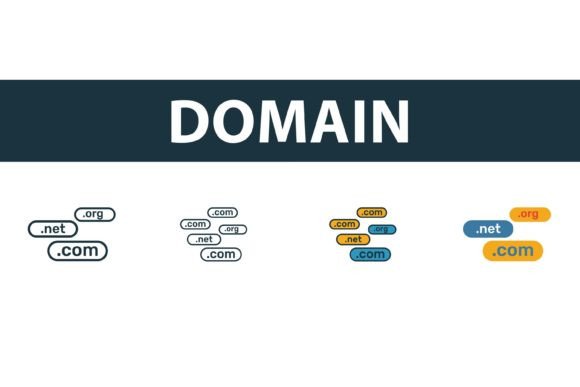
One of the most compelling features of a high-quality domain icon set from a web hosting collection is the variety of styles offered. Typically, these collections include four primary variations: filled, outline, colored, and flat. Each style serves a different purpose and can be used to evoke specific emotions or highlight different aspects of a user interface.
- Filled Icons: These are solid, bold symbols that command attention. They are ideal for active states in navigation menus or for highlighting key features on a landing page. Their weight makes them highly visible, even at smaller sizes.
- Outline Icons: Also known as line icons, these are minimalist and elegant. They use thin strokes to define shapes, offering a clean and modern look. Outline icons are perfect for secondary actions or when you want a lighter visual footprint that doesn’t overwhelm the content.
- Colored Icons: These icons incorporate multiple hues to add vibrancy and personality. They are excellent for marketing materials, presentations, or sections of a website where you want to inject energy and creativity. Color can also be used strategically to categorize information or draw the eye to specific calls to action.
- Flat Symbols: Flat design is characterized by two-dimensional elements and a lack of realistic details like shadows or gradients. This style is widely popular in modern web design due to its clarity and scalability. Flat domain icons are versatile and work well across various devices and screen resolutions.
Having access to all four styles within a single package allows designers to maintain consistency while adapting to different contexts. For instance, you might use outline icons for your main navigation bar to keep it sleek, but switch to filled icons when a user selects a menu item to provide clear feedback.
The Practical Value of Vector Graphics
When downloading a professional domain icon set, you will typically receive files in several formats: EPS, JPG, AI, and SVG. Understanding the difference between these formats is crucial for maximizing their utility.
The true power of these icons lies in their vector nature. Vector graphics, stored in formats like AI (Adobe Illustrator) and EPS (Encapsulated PostScript), are defined by mathematical equations rather than pixels. This means they can be scaled up or down infinitely without losing quality. Whether you need a tiny icon for a mobile app or a massive graphic for a billboard, the image remains crisp and sharp. This scalability is indispensable in today’s multi-device world, where websites must look perfect on everything from smartwatches to 4K monitors.
SVG (Scalable Vector Graphics) is particularly important for web development. As an XML-based vector image format, SVGs can be styled with CSS and manipulated with JavaScript. This allows for dynamic interactions, such as changing an icon’s color on hover or animating it to indicate loading status. For developers, having access to SVG files means greater flexibility and better performance, as vector files are often smaller in size than their raster counterparts.
On the other hand, JPG files are raster images. While they are not scalable without quality loss, they are universally compatible and easy to use in documents, emails, or platforms that do not support vector formats. Including JPGs in the package ensures that non-designers can still utilize the icons for basic needs.
Enhancing User Experience and Branding
Beyond aesthetics, domain icons play a functional role in enhancing user experience (UX). In web hosting dashboards, for example, users often manage multiple domains, servers, and security settings. A well-designed icon set helps differentiate these services at a glance. Instead of reading lengthy labels, users can quickly identify their email settings, DNS records, or SSL certificates through recognizable symbols. This reduces cognitive load and speeds up task completion.
From a branding perspective, customizing these icons to match your company’s color scheme and style guide reinforces brand identity. When clients see consistent imagery across your website, invoices, and support portals, it strengthens their recognition and recall of your brand. It transforms a generic service into a distinctive experience.
Common Misconceptions About Icon Usage
A common misunderstanding is that icons can replace text entirely. While icons are powerful, they should rarely stand alone without labels, especially for complex functions. Ambiguity can lead to user frustration. For instance, a gear icon usually means "settings," but in a specific context, it might mean "tools" or "configuration." Pairing icons with clear text labels ensures accessibility and clarity for all users, including those using screen readers.
Another assumption is that more detailed icons are always better. In reality, simplicity often wins. Overly complex icons can become illegible at small sizes. The beauty of a professional domain icon set is that it balances detail with clarity, ensuring readability across all dimensions.
How to Choose and Implement the Right Icons
Selecting the right domain icon set involves considering your target audience and the tone of your brand. If you are running a corporate web hosting service, a clean, flat, or outline style might convey professionalism and efficiency. If you are a creative agency offering domain services, colorful and filled icons might better reflect your innovative spirit.
- Assess Your Needs: Determine where the icons will be used—navigation, buttons, infographics, or presentations.
- Check Compatibility: Ensure the file formats provided (EPS, AI, SVG, JPG) align with your design and development tools.
- Test for Scalability: Verify that the icons remain clear at both small and large sizes.
- Maintain Consistency: Stick to one style family throughout your project to avoid visual disjointedness.
By integrating a high-quality domain icon set into your digital assets, you invest in the clarity, professionalism, and usability of your online presence. These small graphical elements may seem minor, but their cumulative effect on user perception and interaction is profound. Whether you are a seasoned developer or a beginner launching your first website, understanding and utilizing these creative symbols can elevate your project from functional to exceptional.
In conclusion, the domain icon set is more than just a collection of images; it is a vital tool for effective digital communication. By leveraging the versatility of filled, outline, colored, and flat styles, and utilizing the scalability of vector formats like SVG and AI, you can create a seamless and engaging user experience. As the web continues to evolve, the importance of clear, consistent, and creative visual elements will only grow, making these icon sets an indispensable resource for anyone involved in web hosting and digital design.